


The Future Is Here: Stunning Net Zero Buildings Across the Globe
- John Rountree
- Jul 7
- 2 min read
We’ve been sharing quite a bit about the work we’re doing in residential design around Fairfield County, CT and Westchester County, NY. But we thought it might be of interest to show you some surprising and innovative examples of net zero energy homes and buildings from around the world:

The Bullitt Center (Seattle, USA)
Often called the “greenest commercial building in the world,” this office building generates all its own energy with a massive solar array, collects rainwater, and uses composting toilets. Its design pushes the limits of what’s possible for urban sustainability.

The Edge (Amsterdam, Netherlands)
This futuristic office is powered by solar panels and uses smart technology—like LED lighting and groundwater cooling—to minimize energy use. It’s so efficient, it even shares energy with neighboring buildings.

The Unisphere (Maryland, USA)
The world’s largest net zero energy building, the Unisphere uses nearly 3,000 solar panels, an “energy wheel” for real-time monitoring, and even an indoor pool to help regulate temperature. Its dramatic glass curves make it a local landmark.

The Floating Office Rotterdam (Netherlands)
This three-story wooden office actually floats on water, adapting to rising sea levels. It’s powered by rooftop solar panels and uses harbor water for cooling—a clever solution for climate resilience.

Aktiv-Stadthaus (Frankfurt, Germany)
This multi-story apartment building does more than break even—it produces more energy than it consumes! Residents benefit from solar-heated water, energy recovery ventilation, and a rooftop covered in efficient solar panels.
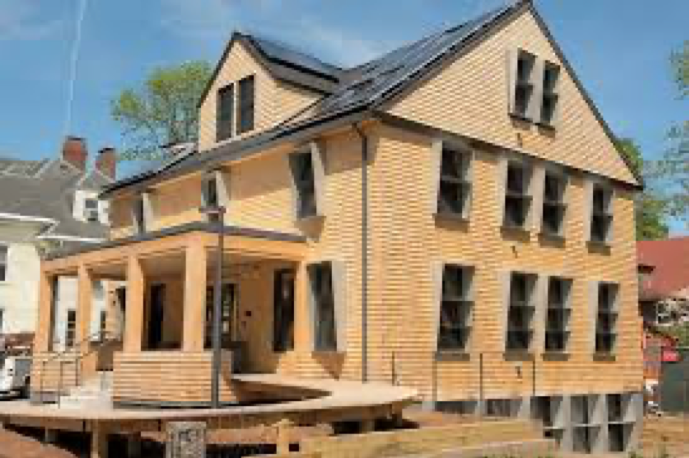
HouseZero (Harvard University, USA)This project transformed an old building into a net zero energy showcase, using super-insulated walls, triple-glazed windows, and a smart ventilation system. It proves that even historic buildings can reach net zero.

Indira Paryavaran Bhawan (New Delhi, India)
India’s first net zero energy building, it uses over 50% green outdoor space, maximizes natural daylight, and is oriented for optimal solar gain—showing net zero is possible even in hot, crowded cities.

Environmental Nature Center & Preschool (California, USA)
This school generates 60% more energy than it uses, thanks to solar panels and clever design. It’s a rare example of a net-positive building for young learners.

Schwaikheim Housing and Workshop (Stuttgart, Germany)Built almost entirely from reusable materials, this rural apartment and workshop complex uses south-facing windows, heat pumps, and solar panels to achieve net zero—even in a small village.

The Joyce Centre for Partnership & Innovation (Hamilton, Canada)
As the largest net zero institutional building in Southern Ontario, it uses solar “wings,” geothermal heating, and triple-glazed windows—serving as both a lab and a model for future buildings.
These examples show that net zero energy isn’t just for new, high-tech offices—it’s happening in homes, schools, historic renovations, floating buildings, and even entire apartment complexes, across climates and continents. Interested in how you might benefit from integrating net-zero design in your project? It’s one of my favorite topics! Just give me a call and let’s talk.


It’s inspiring to see how net-zero design is shaping the future of architecture. At HPW Architecture https://www.hpw.co.uk/, we’re proud to be part of this global shift creating sustainable, energy-efficient buildings that balance innovation with environmental responsibility. If you’re interested in learning more about our approach to net-zero design, visit HPW Architecture to explore our work.